

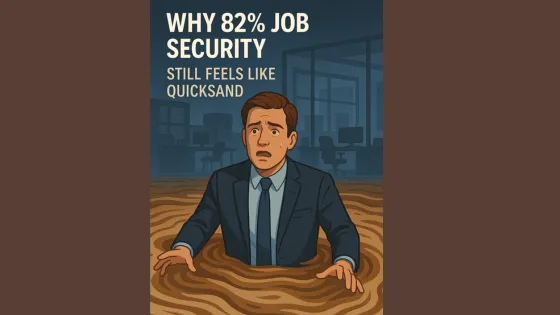
Why 82% Security Still Feels Like Quicksand
Eighty-two percent of your employees feel secure in their jobs right now. Your HR metrics look solid. Retention is acceptable. People show up, do their work, collect their paychecks.
So why does your workplace feel like everyone's standing in quicksand—present but slowly sinking, secure but not safe?
The answer lies in the other number: only 62% of those "secure" employees believe their current working relationship will last. This 20-point gap between present security and future confidence isn't just a statistic. It's the sound of your organization slowly cracking under invisible strain.
Welcome to what I call "quiet cracking"—where people can simultaneously feel secure and trapped, stable and desperate, okay today and terrified about tomorrow.
The Illusion of Stability
Here's what 82% security actually looks like:
Maria has been with your organization for six years. She's good at her job. Performance reviews are solid. She's not worried about being fired. By any traditional measure, she's secure.
She's also mentally rehearsing her resignation letter.
Why? Because security isn't safety. Security means "I probably won't lose this job." Safety means "I can grow here, contribute meaningfully, and build a future worth staying for." Maria has security. She doesn't have safety. And humans need both.
The quicksand feeling comes from this disconnect. You're standing on seemingly solid ground while simultaneously sinking. Every day you show up knowing you're okay for now but doubting there's a meaningful future. That's not stability—that's suspended animation.
The Neurobiology of Quicksand
When your brain detects threat—which includes uncertainty about the future—it activates your survival systems. Heart rate increases. Cortisol rises. Executive function gets suppressed in favor of survival.
Here's the cruel part: this happens even when there's no immediate danger. Anticipated threat activates the same systems. That 20-point gap between security and confidence? Your employees might be objectively secure today, but if they don't believe they have a future with you, their nervous systems are responding to threat.
The result? People who are technically secure but functionally anxious. Present but scanning for exits. Performing adequately but not investing fully. It's the neurobiological equivalent of standing in quicksand.
The Three Forces Creating Quicksand
1. Economic Uncertainty Meets Workplace Reality
Even when individual job security is high, broader economic uncertainty undermines stability. Employees see layoffs at other companies. They know inflation is eating their wages. They're managing student debt, childcare costs, elder care—all while trying to build some financial cushion.
Your organization might be stable, but that doesn't protect employees from economic reality. And when people are economically anxious, even a secure job doesn't feel secure because they know their salary isn't keeping pace with their actual needs.
This economic stress shows up as decision paralysis, creativity shutdown, hypervigilance, and presenteeism—showing up sick because they can't afford to miss work.
2. The Training Investment Gap
Employees who haven't received training in the past year are 140% more likely to feel job insecure.
Think about the message you send when you stop investing in someone's development. Even employees who are objectively secure understand that job security today doesn't guarantee employability tomorrow. Without ongoing development, they know their skills are slowly becoming obsolete. That's quicksand—standing still while the market moves around you.
3. The Ghost of Changes Past
Your employees remember the last five "strategic initiatives" that disrupted their work without clear benefit. They remember the reorganization that eliminated their colleague's role. They remember promises made and not kept.
Each inadequately managed change creates residual distrust. Your current 82% security is built on the foundation of past instability, and everyone knows it. People aren't necessarily worried about losing their jobs tomorrow—they're worried about what sudden change will destabilize things next month.
This chronic uncertainty keeps nervous systems activated. You can feel secure and anxious simultaneously when you know security is temporary and you don't control when or how it will change.
Why Traditional Responses Fail
Organizations typically respond with predictable interventions that miss the problem: enhanced communication that doesn't address underlying issues, engagement surveys that don't capture feeling secure but unsafe, retention bonuses that don't address neurobiological needs, and culture initiatives disconnected from actual sources of insecurity.
These fail because they address symptoms rather than the root cause: nervous systems responding to chronic threat.
The TR-EQ Solution: Building Solid Ground
Trauma-Responsive Emotional Intelligence (TR-EQ) provides employees with internal capabilities to navigate uncertainty without going into survival mode.
TR-EQ teaches emotional regulation to manage anxiety, present-focus skills for staying engaged despite uncertainty, connection-building for stability, impact-based framing without catastrophizing, and choice-making capacity under stress.
When employees have these skills, that 20-point gap starts to close—not because the future becomes more certain, but because people feel capable of navigating uncertainty.
Building Solid Ground: Organizational Responses
TR-EQ skills matter, but they're not sufficient. Organizations must also address the structural issues:
Address Economic Reality: Compensation reviews accounting for actual cost-of-living increases, benefits addressing real financial stressors, transparency about earning potential, and flexibility reducing expenses.
Invest in Genuine Development: Mandatory professional development, career pathing, future-focused skills training, and TR-EQ development.
Create Predictable Change Processes: Advance notice, employee involvement in design, transparent decision-making, adequate support, and honest acknowledgment of difficulties.
Build Trust Through Consistency: Keep promises, communicate transparently, admit mistakes quickly, and match behaviors to stated values.
The Bottom Line
Eighty-two percent security feels like quicksand because security without confidence is slow-motion instability. Your employees aren't ungrateful or unreasonably anxious—they're responding to the real gap between present stability and future possibility.
Traditional responses fail because they don't address nervous systems activated by chronic uncertainty. TR-EQ skills help individuals manage uncertainty responses, while organizational changes address insecurity sources.
The goal isn't 100% confidence—that's unrealistic. The goal is closing the gap enough that people can function, grow, and contribute without constantly feeling like they're sinking.
Your employees deserve better than quicksand. So does your organization. When people spend energy managing anxiety about the future, they can't invest it in building that future.
Solid ground is possible. But it requires addressing the real problem: not that people aren't secure enough, but that security alone isn't enough.
___
Elizabeth Power, M.Ed., founder of The Trauma-Informed Academy, helps organizations build workforce stability through TR-EQ (Trauma-Responsive Emotional Intelligence) development. Learn more at http://thetraumainformedacademy.com



Email our Admin:
©Copyright 2025 EPower & Associates, Inc. All Rights Reserved.
Privacy Policy | Terms of Use
Featured On...
