

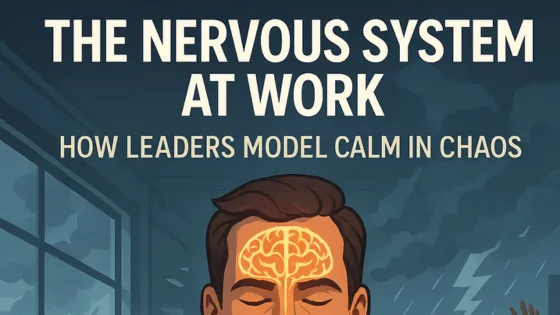
The Nervous System at Work: How Leaders Model Calm in Chaos
Your team is in crisis mode. A major project just derailed. A client is furious. Systems are down. Everyone's looking at you.
What they're actually looking for isn't your brilliant solution—at least not yet. They're looking for a neurobiological signal: Is it safe? Should I panic? Can I think clearly, or do I need to go into survival mode?
Your nervous system is answering these questions before you open your mouth. And your team's nervous systems are listening.
This is co-regulation—the phenomenon where one person's regulated nervous system helps regulate another's. It's the most powerful leadership tool you've never been trained to use.
The Neuroscience of Leadership Presence
Here's what most leadership training misses: Your emotional state is contagious. When you walk into a room anxious, your team becomes anxious. When you're calm, they calm down. This isn't metaphor—it's neurobiology.
Human nervous systems are wired to attune to each other, especially in hierarchical relationships. Your team is constantly scanning you for threat cues. Not consciously—their nervous systems are doing this below awareness, reading your facial expressions, tone of voice, body language, and energy.
When you're dysregulated—anxious, angry, overwhelmed—your team's nervous systems detect threat and activate their own stress responses. Heart rates increase. Cortisol rises. The prefrontal cortex (where complex thinking happens) goes offline.
Suddenly, everyone's operating in fight-or-flight mode. Creative problem-solving becomes impossible. Collaboration deteriorates. Mistakes multiply. Not because people are incompetent, but because stressed brains literally can't access their full capabilities.
The opposite is equally true. When you're genuinely regulated—calm but not checked out, present but not reactive—you create a neurobiological environment where people can think clearly, take appropriate risks, and access their best capabilities.
This is why "executive presence" matters. It's not about charisma. It's about nervous system regulation.
What Regulated Leadership Actually Looks Like
Regulated doesn't mean emotionless. It doesn't mean pretending everything's fine when it's not. It means you can feel the full range of emotions without being hijacked by them.
In a crisis, regulated leaders:
Name reality without catastrophizing: "This is serious, and we need to address it immediately" rather than "This is a complete disaster."
Maintain steady energy: Not flat or robotic, but consistent. Your tone, pace, and body language signal that you're in control of yourself even if you're not in control of the situation.
Focus on next steps: "Here's what we're going to do" shifts people from panic to action, from helpless to capable.
Acknowledge emotions without amplifying them: "I know this is frustrating" validates without adding fuel to the fire.
Take strategic pauses: When everyone's talking over each other, a regulated leader can pause, breathe, and reset the room's energy.
Compare this to dysregulated leadership: visible panic that spreads through the team, rapid-fire questions that increase anxiety, blame that triggers defensive responses, decisions made from fight-or-flight, and energy that swings between intense and withdrawn.
Your team needs you most when things are hardest. But if you're dysregulated, your presence makes things worse, not better.
Building Your Regulation Capacity
The good news? Nervous system regulation is a learnable skill. The bad news? It requires practice, especially if you learned leadership in environments where dysregulation was normalized.
Before high-stress situations:
· Check your baseline: Where's your nervous system right now? You can't regulate what you can't sense.
· Use regulation techniques: Three minutes of conscious breathing, a brief walk, or grounding exercises can shift your state.
· Set your intention: What energy do you want to bring? Your nervous system responds to clear intention.
During high-stress situations:
· Monitor yourself: Notice when you're getting activated—heart racing, tension rising, thinking narrowing. These are signals to regulate, not push through.
· Anchor physically: Feel your feet on the floor, your body in the chair. Physical grounding helps nervous system regulation.
· Slow down deliberately: Resist the urge to match the room's frantic energy. Your steady pace helps everyone else slow down.
· Use your voice strategically: Lower, slower speech activates calming responses. Fast, high-pitched speech activates stress responses.
After high-stress situations:
· Debrief your nervous system: Don't just move to the next crisis. Take five minutes to let your nervous system process what happened.
· Notice impact: Did your regulation help the team stay functional? Honest assessment drives improvement.
· Restore your baseline: Leadership in crisis is depleting. You need practices that replenish your regulation capacity.
The TR-EQ Advantage
Trauma-Responsive Emotional Intelligence (TR-EQ) provides specific skills that build regulation capacity:
Elastic Emotions: The ability to identify what you're feeling and turn the intensity up or down, staying present in crisis without shutting down or melting down.
Finding Connections: Using positive memories and relationships for self-soothing, accessing internal stability even when external circumstances are chaotic.
Impact-Based Awareness: Understanding how stress affects your thinking, feeling, and decision-making, recognizing when you're operating from survival mode rather than executive function.
Leaders who develop TR-EQ capacities become what their teams need most: a regulated presence that creates neurobiological safety even in difficult situations.
The Organizational Impact
When leaders consistently model regulated responses to stress, psychological safety increases, performance improves, stress becomes manageable rather than compounding, resilience builds, and culture shifts as co-regulation cascades through the organization.
The Bottom Line
Leadership isn't just what you say or decide. It's the neurobiological state you bring to every interaction. Your nervous system is always communicating—the question is what it's saying.
In chaos, your team doesn't need you to have all the answers. They need you to be regulated enough that they can access their own thinking. They need your nervous system to signal: "We can handle this. Stay focused. Think clearly."
This isn't about being superhuman. It's about being human enough to recognize when you're dysregulated and skilled enough to do something about it.
Your leadership presence isn't just your reputation or charisma. It's your nervous system state. And that state is either creating capacity in your team or depleting it.
The choice is yours. But first, you have to learn the skill.




Email our Admin:
©Copyright 2025 EPower & Associates, Inc. All Rights Reserved.
Privacy Policy | Terms of Use
Featured On...
