

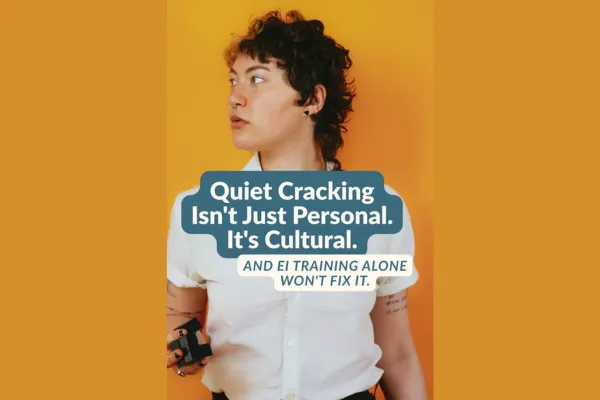
Quiet Cracking Isn't Just Personal. It's Cultural. And EI Training Alone Won't Fix It.
Most organizations treat Quiet Cracking as a people problem. Someone's disengaging. Someone's reactive. Someone who used to give everything now gives just enough. The instinct is to look at the individual — their skills, their mindset, their emotional intelligence — and figure out what needs to change.
That instinct is understandable. It's also incomplete.
Quiet Cracking — the slow erosion of meaning, connection, and inner reserves in people who still look fine from the outside — doesn't happen in a vacuum. It happens inside cultures. And more often than most organizations want to admit, the culture itself created the conditions for cracking.
Overwhelming Experience Doesn't Stay in One Person
When people carry the weight of overwhelming experience into their workplaces — exposure to suffering, chronic under-resourcing, constant change, the kind of stress that never quite gets named — that weight doesn't stay contained. It moves.
It shapes how people talk to each other. How conflict gets handled. How safe it feels to tell the truth. Over time, it becomes the tone of the whole workplace. The background hum everyone feels but no one fully addresses. Because no one has language for it. And the culture has learned not to look directly at it.
This is how an organization carries Quiet Cracking at the cultural level. The signs are clear if you know what to look for. A team that's polite but distant. Leaders who manage perception more than they develop people. Meetings where real talk happens in the parking lot. An unspoken rule that certain things aren't discussed.
Why EQ Training Can't Reach This
EQ training develops individuals. Those skills are real and necessary. But they're taught as if the person is returning to a neutral container — as if the culture will support what they just practiced. It often doesn't.
When the culture is shaped by accumulated overwhelming experience, when unspoken norms are built around self-protection, when trust has worn down — individual skill-building hits a wall. People leave the training room with new language and real intentions. Then they return to an environment that trains those things back out of them.
You can't skill-build your way past a culture organized around survival. If the goal is genuine aliveness — not just less cracking — the work has to happen at the cultural level.
What It Looks Like to Address Both
TR-EQ was designed with both layers in mind. At the individual level, it accounts for what overwhelming experience does to EQ capacity and builds skill development on that honest foundation. At the cultural level, it creates shared language and shared tools that shift the container itself — not just the people inside it.
At its root, Quiet Cracking is a process of disconnection. It's what happens when people stop believing their presence matters, that their effort will be seen, that the culture is on their side. The path forward isn't more training on top of a cracking foundation. It's building something genuine underneath.
If this is the conversation your organization needs to have, let's have it. Visit http://the-tia.org **to book a consultation or speaking engagement, or schedule a call at **https://elizabethpower.com/calendar.



Email our Admin:
©Copyright 2025 EPower & Associates, Inc. All Rights Reserved.
Privacy Policy | Terms of Use
Featured On...
