

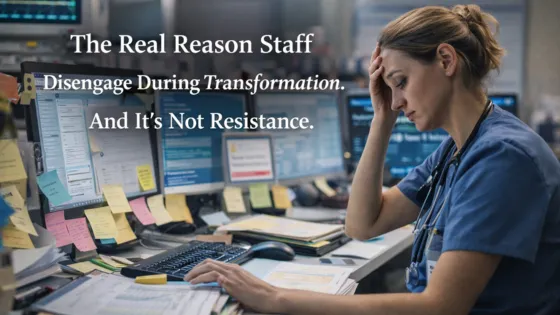
The Real Reason Staff Disengage During Transformation (And It's Not Resistance)
You've seen it. Maybe you're living it right now. I sure know my personal friends in healthcare are.
Leadership announces a new EHR system, another budget realignment, a restructuring that will "streamline operations." Everyone nods in the all-staff meeting.
Then, from the leader’s perspective—nothing. Or worse: passive compliance masking active shutdown.
Your best people go through the motions. Informal leaders go quiet. Performance flatlines. The energy that used to fuel your organization leaks out through invisible cracks.
Leadership calls it resistance. HR names it change fatigue. Consultants blame poor change management.
But here's what's actually happening: your staff aren't resisting transformation. Their nervous systems are protecting them from one more threat they don't have capacity to handle.
What Looks Like Resistance Is Actually Survival Mode
When we talk about "quiet cracking" in healthcare, we're describing what happens when people operate beyond capacity for too long. It's the stage right before burnout, when your brain starts making executive decisions about what it can't afford to care about anymore.
Here's what neuroscience shows us: when people are already managing chronic stress, organizational change doesn't register as opportunity. It registers as threat. The amygdala activates the same response it would for physical danger. Executive function narrows. Capacity for learning crashes. Tolerance for ambiguity disappears.
This isn't resistance. It's your nervous system doing exactly what it evolved to do: protect you from overwhelm by shutting down nonessential functions. Like enthusiasm for the new EHR. Like patience during restructuring. Like trust that this budget cut will be the last one.
Why Healthcare Transformation Keeps Failing
Think about what you're asking staff to metabolize:
The EHR that promised easier documentation but added hours to their day. The restructuring that eliminated people they relied on. The budget "realignment" meaning last year's workload with fewer resources. The political conflicts turning every decision into a battle.
Plus the baseline they're already carrying: pandemic trauma, staffing shortages, moral injury from being unable to provide the care they were trained to give, chronic exposure to suffering.
They're not resisting transformation. They're quietly cracking under cumulative weight.
The data confirms it. Research tracking 53,295 employees through organizational change found transformation consistently increases stress—time pressure, working beyond capacity—regardless of how well-intentioned. EHR implementation alone elevates burnout risk significantly, with stress that never returns to baseline. Restructuring damages wellbeing whether you cut staff or not. The uncertainty alone dysregulates nervous systems already running on fumes.
What Actually Works: Trauma-Responsive Transformation
When organizations understand disengagement isn't resistance—it's a predictable nervous system response to overwhelming demand—everything changes.
The question shifts from "How do we get them to comply?" to "How do we support their capacity to adapt?"
That's where trauma-responsive emotional intelligence comes in. When people have tools to regulate stress responses, when leadership creates psychological safety during uncertainty, when organizations pace change to match human neurological capacity—transformation becomes possible.
Your staff want to be engaged. They want to make things better. But they can't access that part of themselves when their nervous systems are in survival mode.
The transformation your organization needs isn't just in systems and structures. It's in how you support the humans navigating those changes.
On Wednesday, February 25 at 11:00am Central Time, please join me for a webinar on this topic. We will further the discussion and reveal the hidden warning signs that predict turnover. Register here: https://thetraumainformedacademy.com/catching-quiet-cracking




Email our Admin:
©Copyright 2025 EPower & Associates, Inc. All Rights Reserved.
Privacy Policy | Terms of Use
Featured On...
