
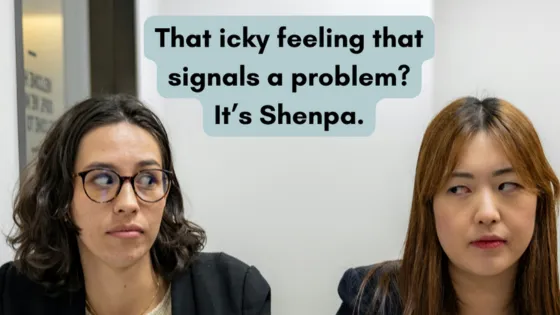
That Icky Feeling that Signals a Problem?--It’s Shenpa
Have you ever been in a perfectly fine mood... and then someone says that one thing, and suddenly you're not fine anymore? Your jaw tightens. Your mind starts looping. You say something you didn't mean to say, or you go completely quiet when you meant to speak up.
You just got hooked by your urge to avoid discomfort--you got shenpa'd.
Shenpa (pronounced shen-pa) is a Tibetan Buddhist concept that roughly translates to "attachment" — but that doesn't quite capture it. It's more like that sticky, charged feeling you get when something hooks you. The itch you can't stop scratching. The old wound that still knows exactly how to sting.
Most of us have been living with our shenpas for so long, we think they're just... us. We think this is how I am — when really, it's a habit of the nervous system doing what it learned to do a long time ago.
Here's why that matters beyond your personal life: what lives inside individuals eventually lives inside organizations too. The unexamined reaction that shuts someone down in a supervision conversation. The triggered moment in a team meeting that nobody names, but everybody feels. The pattern that keeps repeating across departments no matter how many trainings get scheduled. At The Trauma Informed Academy, we call the cumulative effect of all that quiet cracking — the slow, silent drift that happens when people are running on stress fumes for too long. Shenpa is often the hidden fire underneath it. And you can't address what you can't see.
That's exactly why naming things matters so much in this work.
The Little Book of Shenpa, co-authored by Elizabeth Power, M.Ed., and Gail Kaplan, gives readers a warm, funny, dictionary-style guide to the many flavors of shenpa — all the hooks, spirals, and very human reactions that show up in everyday life. And it does it with humor. Because sometimes the most healing thing you can do is read a sentence that perfectly describes your most embarrassing inner monologue and think, oh my goodness, that's me.
That moment of recognition — that laugh of relief — is itself a kind of freedom. It's the beginning of awareness. And awareness, as anyone in trauma-informed work will tell you, is where change actually starts. Not in the policy manual. Not in the performance review. In the moment a person finally has words for something they've been carrying for years.
This book isn't about fixing yourself. It's about seeing yourself — with warmth, with a little wit, and without judgment. That humanistic thread runs through everything we do at TIA.
So if you've ever white-knuckled your way through a hard conversation, avoided a colleague's email for two weeks, or smiled and said "I'm fine" when you were absolutely not fine... this book was written with you in mind.
You're not broken. You're wrestling with shenpa. And there's a difference.
The Little Book of Shenpa by Elizabeth Power and Gail Kaplan is available now at findingthefunny.org and on Amazon. Pick it up — and stay tuned, because the organizational story that follows? That's coming soon too.
(We’ll update you on the launch next week!)



Email our Admin:
©Copyright 2025 EPower & Associates, Inc. All Rights Reserved.
Privacy Policy | Terms of Use
Featured On...
