

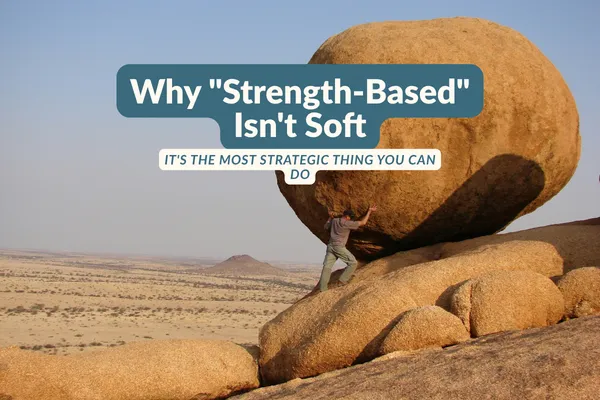
Why "Strength-Based" Isn't Soft — It's the Most Strategic Thing You Can Do
I hear this sometimes when I describe strength-based work. "That sounds nice." Said in a tone that means: that sounds soft.
I want to address that directly.
Focusing on what people can do instead of cataloguing what's gone wrong isn't the warm, fuzzy option. It's the strategic one. And the evidence has been making that case for a long time.
A Weed Is Only a Weed in the Wrong Place
One of the things I love about growing up in Appalachia is what we knew about plants. A weed is only a weed when it's a plant that's in the way of something else you want. Put it somewhere else, and it might be exactly what the ground needs.
That's not just garden wisdom. That's a framework.
Every person I've ever worked with — every person who's ever sat across from me carrying the weight of what life handed them — had something that was functioning as a weed. A way of responding, a pattern, a behavior that was getting in the way.
The medical model says: pull it out. Treat it. Manage it. Medicate it if necessary.
TR-EQ says: look closer first. Because most of the time what looks like a weed is a root system. And root systems don't disappear when you pull the top off. They just go underground and come up somewhere else.
What Actually Grows New Capacity
Here's what the research shows. And here's what forty years of field work confirms.
You don't grow new capacity by focusing on damage. You grow it by building the conditions where growth is possible — and then by practicing the new thing, in real life, over and over, until it becomes the pattern that runs instead.
In Hawaii, we got recidivism in a residential treatment program below fifteen percent over a five year period. Not by managing symptoms. By treating people as capable of building something. By asking not just what happened to them, but what they could do now.
In Zambia, math scores went up twenty-eight points. Not because we taught math differently. Because we addressed what was in the way of learning. We built the ground before we planted the seeds.
That's strength-based work. It's not soft. It's what actually moves the needle.
Why It Matters for Organizations Too
Organizations quietly cracking think they need a diagnostics program. Identify the problems. Name the dysfunctions. Fix the broken parts. And sometimes they do need to name things. TR-EQ doesn't skip that.
But what creates lasting change is starting to build what's possible. What trust looks like when it's present. What genuine connection feels like when it's practiced. What it means for a team to be not just functional but genuinely alive.
You can't diagnose your way to Unbreakably Alive. You can only build your way there.
And building — real, incremental, grounded-in-what-works building — is exactly what TR-EQ is designed to do as the driver of change in the journey from Quiet Cracking to Unbreakably Alive.
If the tools you've been using focus mainly on what's wrong, and the needle still isn't moving — maybe the problem isn't the people. Maybe it's the question.
Ready to ask a different question — and get a different result? Visit http://the-tia.org to learn about our programs or book a consultation and speaking engagement.


Email our Admin:
©Copyright 2025 EPower & Associates, Inc. All Rights Reserved.
Privacy Policy | Terms of Use
Featured On...
