

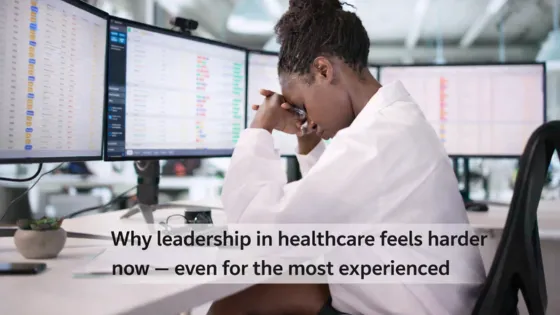
Why leadership in healthcare feels harder now — even for the most experienced
If you're a healthcare leader who's been doing this work for years, you've probably noticed something shifting (maybe even careening). The approaches that used to work—the strategies that built strong teams and navigated tough situations—don't land the same way anymore.
You're not imagining it. And it's not because you've lost your touch.
The Invisible Shift
Your team members are more disengaged and worn out than the numbers show. On paper, they might look fine—showing up, meeting metrics, completing tasks. But underneath that surface competence, something fundamental has changed.
Where there used to be energy for problem-solving, there's now just compliance. Where people used to collaborate voluntarily, they now stick to their lane. Where you used to hear ideas and questions, you now hear silence.
This isn't the kind of disengagement that shows up in exit interviews or engagement surveys. It's quieter, harder to name, and far more widespread than most organizations realize.
What's Actually Happening
After years of pandemic strain, staffing shortages, and constant system changes, many healthcare workers have shifted into a form of protective disconnection. They're not leaving—the job market isn't great, and the grass isn't greener elsewhere. But they're also not investing the way they used to.
It's like they're standing in quicksand. They feel secure enough in their current role (82% of workers report feeling job secure), but when you ask about their future with the organization, that confidence drops to 62%. That twenty-point gap? That's where quiet cracking lives.
They're managing by showing up and doing what's required, but they've stopped bringing their full capacity to work. And here's the thing that makes leadership so much harder: this is often a completely rational response to their reality.
Why Traditional Leadership Approaches Feel Less Effective
The leadership skills that worked when people were engaged don't work as well with teams that are quietly cracking.
Motivational speeches fall flat when people don't believe things will actually change. Recognition programs feel hollow when workers have watched high performers get rewarded with more work rather than better support. Team-building exercises seem tone-deaf when the real problem is that people are exhausted from being asked to do more with less, year after year.
You're not failing as a leader. You're trying to lead people whose nervous systems are responding to chronic uncertainty and overwhelm. Their brains are literally working differently than they used to.
The Neurobiological Reality
When people experience chronic workplace stress without adequate recovery, their nervous systems adapt by reducing emotional investment. It's not a conscious choice—it's a protective mechanism.
Your team members aren't choosing to care less. Their bodies are managing survival by disconnecting from the parts of work that used to bring meaning and satisfaction. This is why the same person who used to light up during strategic planning now just looks tired. Why the nurse who used to mentor new staff now keeps to herself. Why the manager who used to bring solutions now just brings compliance.
What Makes It Harder for Experienced Leaders
If you've been in healthcare leadership for a while, this shift can feel particularly disorienting. You remember when teams had more energy, more resilience, more capacity to weather hard times together. You've led through crises before, and this feels different.
That's because it is different. Previous crises had endpoints. People could dig deep because they knew recovery was coming. But this? This is chronic. The staffing shortages aren't resolving. The system changes keep coming. The resource constraints aren't easing.
Your experience tells you how to lead through acute crisis. But quiet cracking is a chronic condition, and it requires different leadership skills.
The Missing Piece
What most healthcare leaders don't realize is that addressing quiet cracking requires understanding trauma-responsive emotional intelligence (TR-EQ). It's not enough to communicate better or recognize more or restructure teams. You need to help people's nervous systems feel safe enough to re-engage.
This means leading in ways that:
Create predictability in an unpredictable environment
Acknowledge what's hard without pretending it's not
Build genuine agency instead of just asking for input
Address the gap between current security and future confidence
Leadership isn't harder because you're doing something wrong. It's harder because the people you're leading are operating from nervous systems shaped by years of chronic workplace strain.
And until we address that reality directly, all the traditional leadership approaches in the world won't create the engagement you're looking for.



Email our Admin:
©Copyright 2025 EPower & Associates, Inc. All Rights Reserved.
Privacy Policy | Terms of Use
Featured On...
