

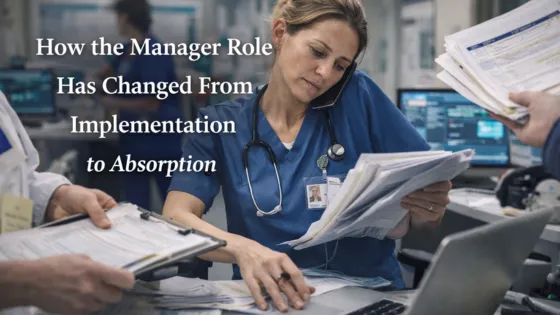
How the Manager Role Has Changed From Implementation to Absorption
Ten years ago, a manager's job during change was clear: learn the system, train your team, monitor compliance, report results.
Today? Managers aren't implementing change—they're absorbing it. Metabolizing the stress, uncertainty, and emotional fallout for everyone around them while their own capacity quietly cracks.
This shift is killing your middle management layer. And most organizations don't even see it happening.
The New Reality: Managers as Emotional Shock Absorbers
Since 204, Gallup's research confirms managers are now more affected by change than any other group—experiencing higher burnout and disengagement than their teams or senior leaders.
The manager role has fundamentally transformed. You're expected to buffer your team from chaos above, absorb emotional fallout in real time, manage resistance to changes you didn't design, and model calm you don't feel—all while managing your own stress about role ambiguity, increased workload, and restructuring that might eliminate your position. It’s emotional labor in addition to everything else.
This isn't implementation. It's absorption. You've become the organization's emotional filtration system—and nobody's cleaning the filter.
The Neurobiological Cost Nobody Talks About
Emotional labor isn't just psychologically draining—it has real neurobiological costs. Cortisol stays chronically elevated. Decision-making capacity diminishes. The ability to regulate your own emotions deteriorates. Empathy fatigue sets in.
This is quiet cracking. Managers aren't dramatically falling apart. They're eroding from the inside out, losing capacity bit by bit while continuing to show up and "figure it out."
Research on emotional labor shows it directly contributes to burnout through emotional exhaustion. When you're managing others through transformation without tools to manage your own nervous system, you're running on a depleting resource with no replenishment plan.
Why This Stays Invisible
Leadership doesn't see what's happening because the system incentivizes managers to hide it. Admitting overwhelm reads as weakness. So managers absorb, suppress, and cope—until they quietly crack or quietly quit.
Organizations measure manager effectiveness by team outcomes, not by the unsustainable effort required to achieve them. The fact that managers are burning through their neurological reserves to keep teams functioning? That's invisible until they break.
What Actually Needs to Change
Organizations can't eliminate the absorption role—someone has to bridge strategy and execution, someone has to manage the human impact. But you can stop expecting managers to do it without capacity-building support.
This is where trauma-responsive emotional intelligence becomes essential. Managers need tools to regulate their own nervous systems, recognize quiet cracking before it becomes burnout, create psychological safety without burning themselves out or falling prey to popular misconceptions about what psychological safety is, and set boundaries that protect their capacity.
When organizations invest in these capacities, managers experience less burnout, teams navigate change more effectively, and transformation actually sticks instead of creating trauma.
The manager role has changed. The question is whether organizations will change how they support managers through it.
On Wednesday, February 25 at 11:00am Central Time, please join me for a webinar on this topic. We will further the discussion and reveal the hidden warning signs that predict turnover. Register here:https://thetraumainformedacademy.com/catching-quiet-cracking



Email our Admin:
©Copyright 2025 EPower & Associates, Inc. All Rights Reserved.
Privacy Policy | Terms of Use
Featured On...
