

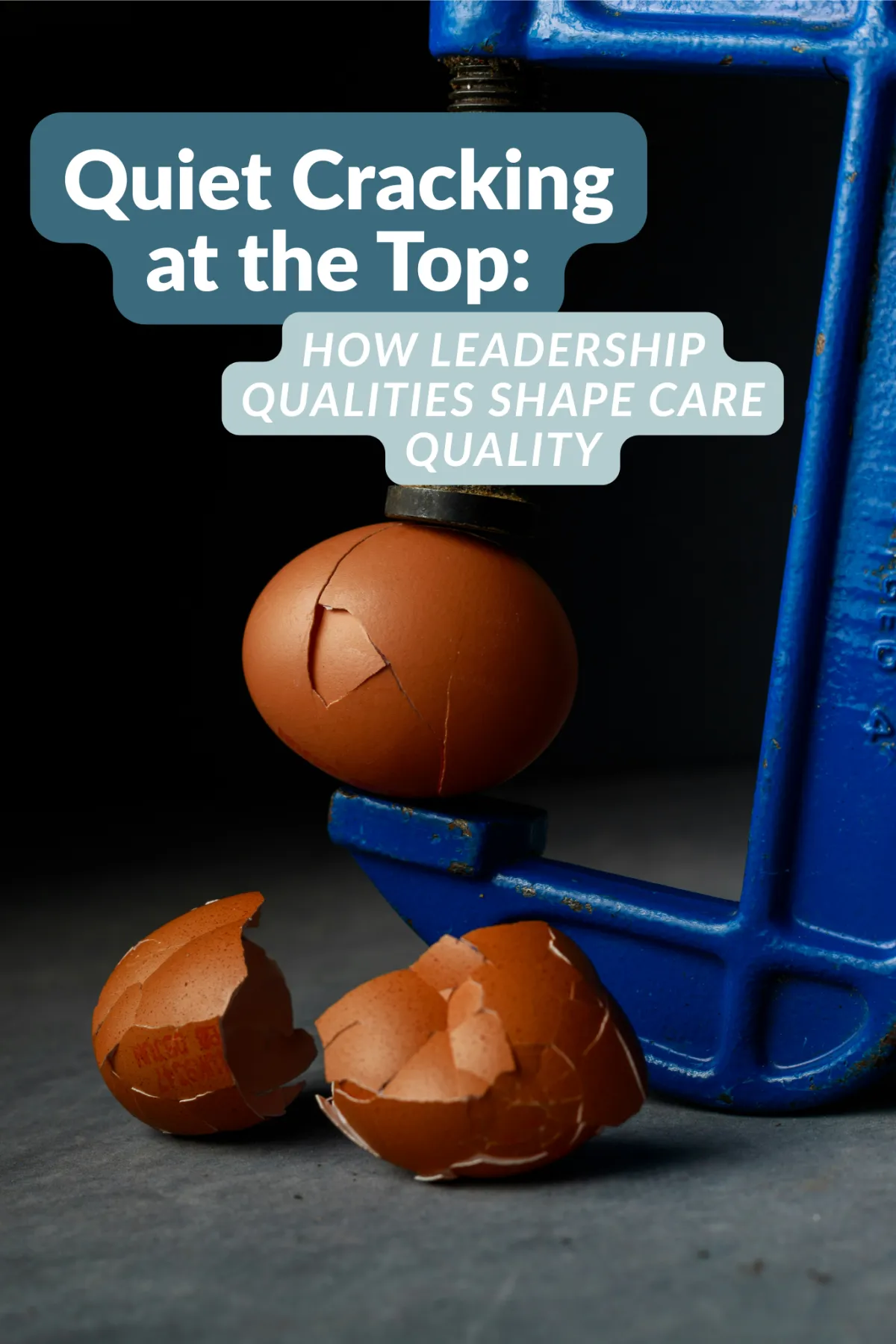
Quiet Cracking at the Top: How Leadership Qualities Shape Care Quality
Here's something most leaders never see.
Research in healthcare, education, and human services makes one thing very clear. The quality of care your staff delivers is shaped by the quality of their work life. Put plainly: how you treat your staff shows up in how they treat the people they serve.
This isn't about carelessness. It's about how humans are wired. We affect each other's nervous systems. We carry the climate of our workplaces with us. Leaders set that climate more than almost anyone else.
When a leader is quietly cracking — when stress has worn down their reserves — those effects don't stay internal. They transmit. They become the culture. And the culture becomes the care.
Leaders Set the Climate
Most leadership training focuses on what leaders do. Their decisions. Their communication. Their ability to develop others. Those things matter. But they sit on top of something deeper.
Who a leader is in any given moment. Their inner state. The stories they're telling themselves. How much their own stress is shaping how they show up.
A quietly cracking leader rarely announces it. They get rigid. They focus on control rather than growth. They treat holding people accountable like punishment. And whether they mean to or not, that tension spreads to everyone.
People are remarkably good at reading safety signals. Before anyone can name what's happening, nervous systems are already scanning. A workplace where mistakes bring shame and effort goes unseen produces the kind of chronic stress that degrades both staff wellbeing and care quality.
Accountability vs. Ownership
This shows up most clearly in how leaders handle mistakes. In most organizations, holding people accountable is a counting method. It measures what went wrong and assigns blame. And it often falls short — because it skips something essential: real ownership.
People can't truly own outcomes they were never empowered to influence. Real ownership requires clarity about what's expected. It requires enough safety to try, fail, and try again. It requires trust that effort will meet something other than scrutiny.
Leaders who build real ownership first find that holding people accountable takes care of itself. Not because consequences disappear. Because the conditions for real performance exist.
What Changes When Leaders Do Their Own Work
When leaders develop real TR-EQ — and build workplaces that reflect it — the results are measurable. Engagement goes up. Errors go down. Retention strengthens. And the people in their care feel the difference, even when they can't name what changed.
This is well documented across healthcare, education, and human services. A leader who has moved through their own Quiet Cracking and emerged with deeper self-awareness and real relational skill builds something lasting.
Your organization's inner life isn't separate from its results. It's the mechanism through which results are produced.
Ready to explore what trauma-responsive leadership development could look like in your organization? Let's start the conversation. Visit http://the-tia.org to learn about our programs or book a consultation and speaking engagement.



Email our Admin:
©Copyright 2025 EPower & Associates, Inc. All Rights Reserved.
Privacy Policy | Terms of Use
Featured On...
