

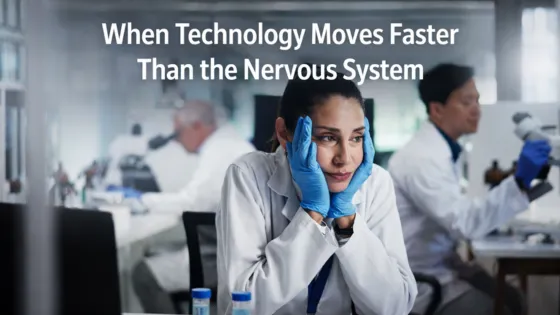
When Technology Moves Faster Than the Nervous System
Every healthcare organization I work with is implementing something new: updated EHR systems, new scheduling software, AI-assisted documentation, digital workflow tools. The technology keeps advancing, and the implementation timelines keep shrinking.
But here's what nobody talks about: your staff's nervous systems can't keep pace with the speed of technological change. And when the brain can't process what's happening fast enough, it does something predictable—it locks up.
What "Locking Up" Actually Looks Like
You've seen it, even if you didn't have words for it:
The experienced nurse staring at the new medication administration screen, suddenly unable to complete a task she's done thousands of times. The competent physician who becomes uncharacteristically flustered trying to navigate the updated charting system. The unit clerk who keeps making the same data entry errors, over and over, despite knowing better.
This isn't resistance. It's not incompetence. It's not even a learning curve problem.
It's a neurobiological response to overwhelm. When change happens faster than our brains can integrate it, we freeze. Not dramatically—not like a panic attack or meltdown. Just... stuck. The thinking gets muddy. The confidence disappears. Simple tasks become insurmountable.
Why This Happens
Your brain has specific capacity for processing new information and adapting to change. That capacity isn't infinite, and it gets depleted when you're already stressed.
Most healthcare workers are already operating with nervous systems shaped by years of chronic workplace strain. They're managing pandemic aftermath, staffing shortages, increased patient acuity, regulatory changes, and a dozen other ongoing stressors. Their capacity for adapting to change is already stretched thin.
Then you add: "Here's a major technology overhaul. Training is Tuesday. Go-live is Thursday. You'll be fine."
Their nervous systems—already taxed—simply can't integrate that much new information that quickly while maintaining everything else they're juggling. So they lock up. Not because they're resisting or failing, but because they're human beings with biological limits.
The Invisible Cost
Here's what makes this so dangerous: locking up looks like poor performance. It looks like people not trying hard enough, not paying attention, not taking the change seriously.
So organizations respond with more training. More monitoring. More pressure to "just get up to speed." Which makes the overwhelm worse, which intensifies the freeze response, which looks even more like resistance or incompetence.
Meanwhile, the actual problem—nervous systems responding to change that's happening faster than they can process—never gets addressed.
What Happens When We Ignore This Reality
I watched a hospital implement a new EHR system using the "rip the Band-Aid off" approach. Six-week timeline, computer training, simultaneous rollout across all units. Leadership kept saying, "This will make your jobs easier once you get through the learning curve."
What actually happened:
28% of staff called in sick the first week
Medication errors increased by 40%
Patient satisfaction scores dropped 15 points
Within six months, 12% of the nursing staff had left
It took 14 months for the team to reach full competence with the system
Compare that to another hospital that understood the nervous system reality. They took six months for implementation, included staff in design decisions, provided trauma-responsive emotional intelligence (TR-EQ) training alongside technical training, and built in extensive support during transition.
Their results:
Sick calls stayed at baseline
Medication errors increased 8% temporarily (recovered by month two)
Patient satisfaction barely shifted
Lost only 4% of nursing staff
Reached full competence in 8 months
The second hospital's approach cost more upfront. But the first hospital's approach cost $2.3 million in turnover, errors, and extended transition time. The second hospital spent $250,000 and got their people through the change intact.
What Your Team Actually Needs
When technology moves faster than the nervous system can adapt, people need:
Time that matches reality. Not the timeline that looks good to leadership or satisfies the vendor contract, but the timeline that allows human brains to actually integrate new skills while managing everything else. Otherwise, it’s like asking someone with a fresh leg fracture to run a football down the field.
Permission to struggle. When you acknowledge upfront that this will be difficult and that struggling is normal, people's nervous systems don't interpret difficulty as personal failure. The freeze response decreases when people know they're supposed to be finding this hard.
Skills for managing overwhelm. This is where TR-EQ becomes essential. When people have tools for regulating their nervous systems under stress—for recognizing when they're locking up and knowing how to get unstuck—they can actually learn during difficult transitions. These same skills help reduce the risks for citations in different settings like F699s, turnover, and boost morale.
Support that addresses the real problem. More training doesn't help a locked-up nervous system. What helps is acknowledgment of the overwhelm, strategies for managing stress responses, and structural changes that reduce the adaptation demand.
Honest communication. Pretending the change won't be disruptive destroys trust and intensifies stress. Telling the truth—"This will be hard. Here's the support we're providing. Here's what we're doing to make it manageable"—helps nervous systems stay regulated enough to learn.
The Bottom Line
Technology will keep advancing. Implementation timelines will stay aggressive. The pace of change in healthcare isn't slowing down.
But your staff's nervous systems have biological limits. Ignore those limits, and you'll keep seeing the same pattern: implementations that cost more than projected, take longer than planned, and leave your workforce more depleted and disengaged than before.
Respect those limits, and you can navigate technological change in ways that build capacity instead of breaking it.
The question isn't whether to implement new technology. The question is whether you're going to work with your team's neurobiology or against it.
Want to talk more about Quiet Cracking?
Register here: https://thetraumainformedacademy.com/catching-quiet-cracking



Email our Admin:
©Copyright 2025 EPower & Associates, Inc. All Rights Reserved.
Privacy Policy | Terms of Use
Featured On...
