

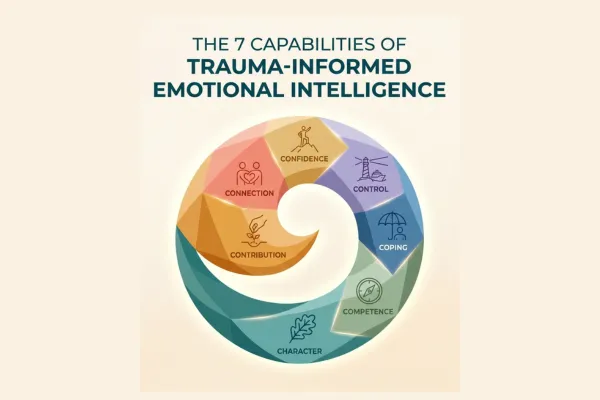
The 7 Capabilities of Trauma-Informed Emotional Intelligence
By Elizabeth Power, M.Ed. | The Trauma Informed Academy
If you have ever walked into a room and immediately sensed something was off — before a single word was spoken — you have felt emotional intelligence working. It is not magic. It is a set of learnable, buildable capabilities. And understanding what those capabilities actually are is the first step toward doing something intentional with them.
Most conversations about emotional intelligence stay surface level. The word gets used in performance reviews, leadership trainings, and hiring criteria without much clarity about what it actually involves. So let's slow down and name the parts.
The framework I work from draws on research by Dr. Kenneth Ginsberg, whose work on resilience identified seven core capabilities — what he called the 7Cs — that together create the internal foundation for how we function in relationship with others and with the demands of our lives. In my work at The Trauma Informed Academy, we weave these into Goleman’s EQ construct of self-awareness, self-regulation, social awareness, social skills, empathy and decision making. Ginsberg’s 7Cs require them. Together, these capabilities form the bedrock of trauma-responsive emotional intelligence.
The 7 Capabilities
Character is a sense of your own values and identity — the deep belief that you are fundamentally a worthwhile person, even when things go wrong. It is what keeps you oriented when circumstances get hard.
Competence is the confidence that you can handle situations effectively. Not that you will always get it right, but that you have what it takes to try, learn, and try again. Without a functional feedback loop — being seen, recognized, and given room to grow — competence erodes quietly.
Contribution is perhaps the most underappreciated of the seven. It is the felt sense that your presence and your effort actually make a difference to someone or something. When contribution collapses — when effort consistently goes unacknowledged — motivation follows it down.
Connection is the experience of real, reciprocal relationships. Not just having people around you, but having people who know you, support your growth, and tell you the truth with care. Healthy connection is not just emotionally satisfying. It is physiologically regulating.
Coping is access to a range of strategies for managing difficulty. The key word is range. People under chronic stress tend to narrow their coping to one or two familiar moves — even when those moves are no longer working. Expanding that range is some of the most practical work we do.
Control is the belief that your choices and actions have real effects in the world. It is the experience of agency — that you are not simply at the mercy of what happens to you, but can influence your circumstances and your responses to them.
Confidence is the outward expression of the other six. It is the grounded belief that you can navigate what comes — not because nothing will go wrong, but because you have the resources to respond.
These seven capabilities are not personality traits you either have or do not. They are dynamic. They build. They deplete. And they respond to the environments we are in and the experiences we carry.
That is what makes them so important — and so worth attending to intentionally.
If you are ready to explore how these capabilities show up in your organization or leadership practice, I would love to connect. Reach out to [email protected] to book a consultation or speaking engagement.




Email our Admin:
©Copyright 2025 EPower & Associates, Inc. All Rights Reserved.
Privacy Policy | Terms of Use
Featured On...
