

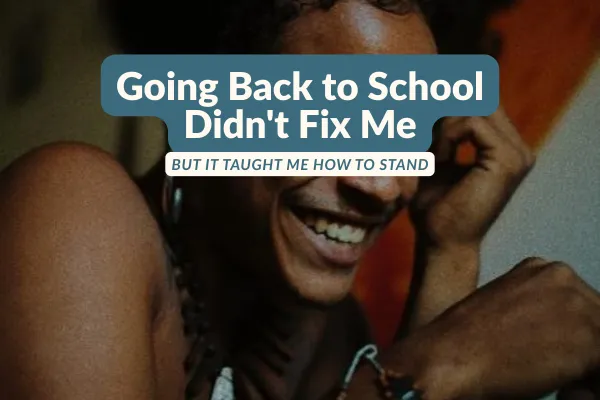
Going Back to School Didn't Fix Me. But It Taught Me How to Stand.
I wasn't supposed to go to graduate school. Not by the story I was telling myself about who I was and what I was capable of. Never mind that I taught myself written Hebrew and Arabic in college, right?
Crippled and crazy people don't get degrees. That was the operating belief in spite of all the evidence. And for a long time, I let it run my life without even knowing it was there.
But here's the thing about beliefs that aren't true. They can run in the background for years. They shape your choices. They make you smaller than you are. And eventually — if you're lucky — something cracks them open.
Going Back Wasn't Easy
Going back to school as an adult wasn't a feel-good story. It was hard. It was disorienting. It required me to show up in rooms where I didn't feel like I belonged and do it anyway.
It required me to hear myself called capable when every old recording said otherwise. It required me to sit with the discomfort of being seen — really seen — by people who were reflecting something back at me that I wasn't ready to believe yet. Me? Vanderbilt? You have to be kidding. Not.
I've since studied Education for Ministry at Sewanee. I've spent two years at the Earlham School of Religion. I've earned a master's degree and gone on to become a Fulbright Specialist for the State Department. I've conducted peer-reviewed research at Georgetown University Medical Center. My work is a foundation in Japan’s national models of trauma-informed care.
None of that happened because I suddenly felt confident. It happened because I learned — slowly, imperfectly — to act in spite of the old story. To let the discomfort be there and move anyway. Not from a position of rebellion, sypmathy, pity or revenge: from knowing the only way out is step by tiny step. patterning the thoughts, feelings, and actions of people who I believed were doing better than I was at the time in terms of being happier, healthier, and more hopeful. Kind of reminded me of my mother requiring my sister and me to do lip exercises so we would sound less like “hillbillies.”
This Is What Unbreakably Alive Actually Looks Like
People sometimes picture Unbreakably Alive as a destination you reach and then stay in. Some elevated state where you're no longer scared, no longer unsure, no longer tender. That's not what it is.
Unbreakably Alive is the ability to feel all of that — the fear, the doubt, the old recordings — and keep moving. Not through force or sheer willpower. Through a real, grounded relationship with your own inner resources.
Going back to school taught me several things I couldn't have learned any other way. It taught me that competence isn't something you have. It's something you build, brick by brick, every time you do the thing you weren't sure you could do. It taught me that connection — real, reciprocal connection with people who believe in you — is not a luxury. It's a survival resource. And it taught me that the story you're telling yourself about who you are is always subject to revision.
That last one changed everything. Ask me sometime about giving up “crippled.”
The Invitation
I'm not telling you to go back to school. I'm telling you that the version of yourself that's been living inside the old story is not the only version available to you.
Standing tall doesn't mean the discomfort goes away. It means you stop letting the discomfort make your decisions for you.
That's learnable. I know because I had to learn it. And if someone who grew up calling herself crippled and crazy (among other things) can end up doing work in dozens of countries and training trauma-informed practitioners — then the ceiling you've put on yourself is almost certainly far lower than your actual reach.
The path is real. The support is available. Visit http://the-tia.org to learn about our programs or book a consultation and speaking engagement.


Email our Admin:
©Copyright 2025 EPower & Associates, Inc. All Rights Reserved.
Privacy Policy | Terms of Use
Featured On...
