

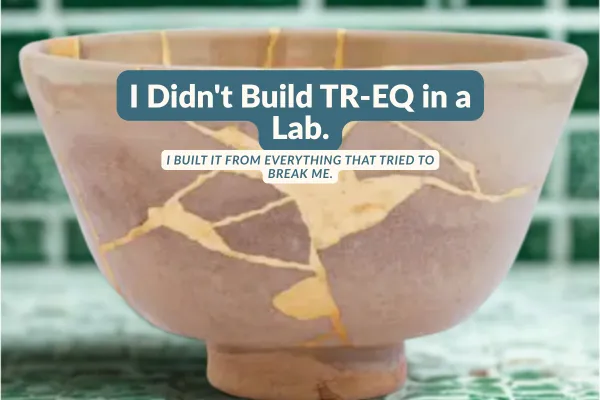
I Didn't Build TR-EQ in a Lab. I Built It From Everything That Tried to Break Me.
I didn't build TR-EQ in a university lab. I built it in the spaces between falling apart and finding my footing. I built it in the field — in addiction treatment programs, in schools, in communities that were carrying more pain than anyone was willing to name. And I built it from my own life.
That matters. Because theory without lived experience is just theory. And I've watched a lot of well-meaning theory fail real people because it was built by someone who'd never had to use it on themselves.
What I've Had to Use It On
I know what it's like to move through the world in a body that doesn't do what you expect. I know what it's like to be seen as threatening because of what you carry — and to become invisible because invisible felt safer. I know what it's like to absorb pain as a professional, year after year, and to have to learn — slowly, imperfectly — how to process rather than just store it.
I know what secondary trauma feels like from the inside. I know what it feels like to love this work and to wonder, in the hard seasons, whether I still have what it takes. That's not weakness. That's honesty. And it's the foundation of everything I teach.
TR-EQ Came From the Inside Out
The Trauma-Responsive Emotional Intelligence framework wasn't handed to me complete. It was built the way most real things are built — through trial, failure, revision, and practice. Building in research and sound theory, bridging the gaps by blending educationb, psychology, social work, and more.
In eight-years of work in a residential treatment program in Hawaii we got recidivism below fifteen percent. Not by being clever, but by treating people as whole human beings whose behaviors made sense in the context of what they'd survived and using the cultural context of their traditional values.
Through five years of SAMHSA-funded work in King County — learning what it takes to build real safety in a real system.
Through work in Zambia, where a trauma-informed approach raised math scores by twenty-eight points. Not because we taught math. Because we addressed what was in the way of learning.
Through my own personal healing, my own spiritual practice, my own daily reckoning with what it means to stay present and grounded in a world that can be genuinely hard.
This Is Why It Works
TR-EQ works because it was built by someone who needed it. That's not a credential. It's a commitment.
When I sit with someone who's quietly cracking — who's still showing up, still delivering, still appearing fine — I'm not observing them from a safe distance. I'm recognizing them. Because I know that territory from the inside.
And when I say the path from Quiet Cracking to Unbreakably Alive is real and navigable — I'm not guessing. I'm reporting. I've walked it. I've walked it with thousands of others. I still walk it. And I've learned that the tools that helped me are the same tools that help people in healthcare systems, in classrooms, in faith communities, and in organizations that are slowly realizing what they've been asking their people to absorb.
The work is personal. It always has been. That's what makes it work.
If you want to work with someone who's walked this path — not just studied it — visit http://the-tia.org to learn about our programs or book a consultation and speaking engagement.



Email our Admin:
©Copyright 2025 EPower & Associates, Inc. All Rights Reserved.
Privacy Policy | Terms of Use
Featured On...
