

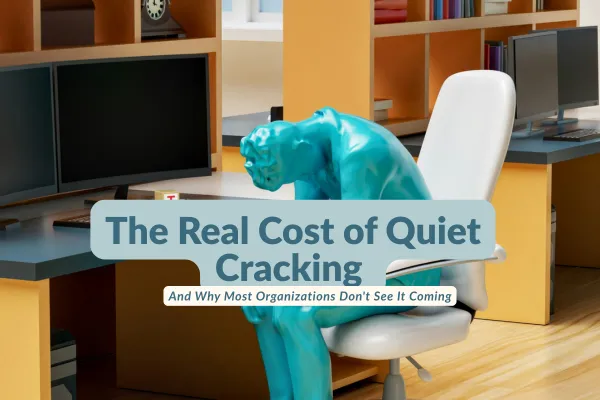
The Real Cost of Quiet Cracking — And Why Most Organizations Don't See It Coming
We can — and should — talk about Quiet Cracking in human terms. The toll on people who are giving everything while quietly losing ground is real. But there's also a business case. And it's significant.
Organizations that understand what Quiet Cracking actually costs make very different decisions about culture investment. It isn't optional. Here's why.
Turnover Is Only the Visible Part
The standard estimate of turnover cost runs 1.5 to 2 times an employee's annual salary. Recruiting, onboarding, lost productivity, and knowledge walking out the door. But that only captures what's measurable on the way out.
It doesn't capture the cost of talent that stays while quietly withdrawing. The person who used to mentor others and now just clocks in and out. The leader who used to drive new ideas and now manages to neutral. The caregiver who used to fight for clients and now documents and moves on. In care settings, that cost extends to the people your organization exists to serve.
Compliance and Quality Risk
In healthcare and long-term care, the link between workforce culture and outcomes is documented. Citations for deficient care don't show up in organizations where staff feel seen and supported. They show up where the human foundation has been quietly eroding — where Quiet Cracking has been the baseline long enough to feel normal.
The citation is rarely the whole story. It's the surface. Beneath it is a workforce running past its capacity. In a culture that's learned to survive rather than thrive. Led by people who are themselves running on empty. Addressing that foundation before a citation always costs less than responding afterward.
The Capacity to Adapt
Quietly cracking organizations lose something less visible but equally costly: the ability to adapt. Change requires real resources. The willingness to try new things. To sit with not knowing. To tolerate an imperfect start. A workforce running on chronic stress doesn't have those resources. It reaches for what's familiar even when familiar isn't working.
The ability to adapt is the defining skill in today's environment. This isn't a soft risk. It's a real one.
The Cost of Waiting
Most organizations wait until crisis to address what's been building for years. A turnover spike. A regulatory action. A key departure. By then, the investment needed to rebuild is far more than proactive work would have cost.
The path from Quiet Cracking to a sustainable, alive culture isn't free. It requires honesty, skilled support, and leaders willing to look at hard things. But it's always less expensive — in human and financial terms — than continuing to absorb the costs of a cracking culture while calling it normal.
If you're ready to look at what Quiet Cracking is costing your organization — and what addressing it could return — let's talk. Visit http://the-tia.org to learn about our programs or book a consultation and speaking engagement.



Email our Admin:
©Copyright 2025 EPower & Associates, Inc. All Rights Reserved.
Privacy Policy | Terms of Use
Featured On...
