

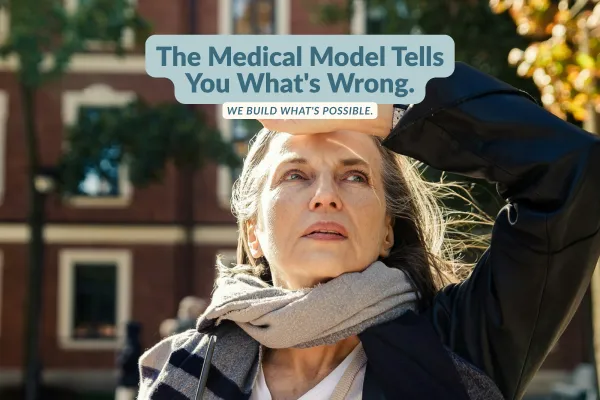
The Medical Model Tells You What's Wrong. We Build What's Possible.log Post
I grew up around people who were plain-spoken about hard things. We didn't have a lot of fancy language for suffering. We just described what we saw. And what we saw was this: when you only name what's broken, you don't give people much to work with.
That's been the central problem with how we've tried to help people for a long time. The medical model — the one most of us grew up in — starts with damage. What's the diagnosis? What's the disorder? What's the dysfunction? Those are real questions. And sometimes they're the right ones.
But they're not the whole story. And when they become the whole story, they limit us.
What the Medical Model Gets Right — and Where It Stops
The medical model is good at naming pain. It's good at identifying what's gone wrong. It gave us language for depression, anxiety, PTSD, and a hundred other real human experiences. That language helped a lot of people understand why they were struggling. It was a step forward.
But here's where it runs out of road.
When the primary question is "what's wrong with you," everything that follows tends to be about managing damage, not building capacity. Treatment is about reducing symptoms. Recovery is about returning to some baseline. And the person in the middle of it all is defined — sometimes forever — by what has happened to them.
I've watched that do real harm. Not because the people in those systems are bad. But because when you're handed a label instead of a map, it's very hard to know which direction to walk.
What TR-EQ Does Instead
Trauma-Responsive Emotional Intelligence--unlocking the key to becoming Unbreakably Alive-- doesn't ignore damage. It doesn't pretend the hard things didn't happen or don't matter. What it does is start somewhere different.
Instead of "what's wrong with you," TR-EQ asks "what happened to you?" And then — and this is the part most models skip — it asks "what can you do now?"
That third question is everything.
Because here's what I've learned in four decades of doing this work: people don't grow into their capacity by cataloguing what's missing. They grow by building what's possible — one small, real, lived experience at a time.
I used to call myself crippled and crazy. That was my medical model label. I gave it to myself before anyone else could get there first. And I stayed smaller than I needed to be for a long time because of it.
What changed wasn't that someone convinced me the label was wrong. What changed was that I started finding out what I could actually do. What I could learn. What I could build. What I could become. In the face of undeniable evidence, I cam to believe in me as much as others did. I came to fit in well enough to get by, find friends, be loved, thrive.
That's a learning model. That's TR-EQ. It’s one of the key pillars that holds up the trek from Quiet Cracking to Unbreably Alive. And it's available to you — whatever label you've been handed, or handed yourself, along the way.
Ready to move from labeling to building? Visit http://the-tia.org to explore our programs or book a consultation and speaking engagement.

Email our Admin:
©Copyright 2025 EPower & Associates, Inc. All Rights Reserved.
Privacy Policy | Terms of Use
Featured On...
