

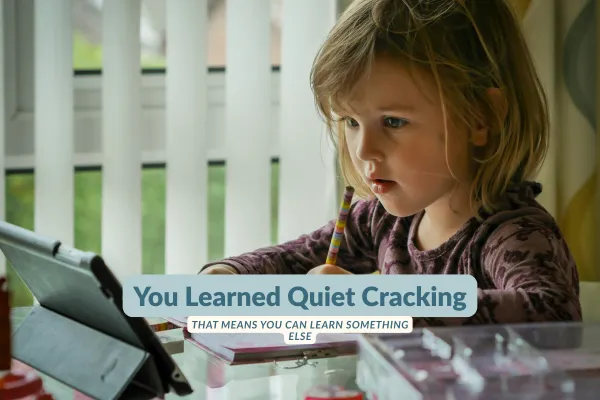
You Learned Quiet Cracking. That Means You Can Learn Something Else.
Here's something I've believed for a long time — and the research backs it up.
You learned Quiet Cracking.
That's not blame. That's good news. Because if you learned it, you can learn something else. That's the whole basis of the learning model. And it's the foundation of Trauma-Responsive Emotional Intelligence.
How Quiet Cracking Gets Learned
Back on Granny's porch, nobody talked about nervous systems or emotional intelligence. But they understood something that a lot of expensive theories still miss.
People become who they practice being.
What we see modeled, what we repeat, what we survive and survive and survive — it all becomes pattern. It becomes the groove we run in. Not because we're weak. Because we're human. And humans learn.
When I was young, I learned that being visible was dangerous. I learned that certain feelings needed to stay inside. I learned that the way to stay safe was to manage — not to live.
I didn't decide those things. I absorbed them. The way you absorb the language your family speaks, or the way you hold your body when you're braced for something hard.
That absorption is learning. And most of the patterns we carry into adulthood — the ones that show up as Quiet Cracking, as burnout, as checking out — started as someone else's pattern that got handed to us before we could evaluate it.
You Can Only Live What You Learn
One of the things I wrote early in my career is this: you can only live what you learn.
It's that simple. And it's that hopeful.
If what you've been living is the fruit of what was modeled and absorbed and practiced — then changing what you live means changing what you learn. Not re-learning everything at once. Not desperately trying to get away from the other patterns or ltrying to kill them off. Not overhauling your personality. Just — incrementally, persistently, with the right support — building new patterns on top of the old ones.
That's what TR-EQ does. It's a learning model, not a treatment model. It doesn't ask what's wrong with you and then try to fix it. It asks what you've been practicing — and then helps you practice something better.
Small Choices. Repeated. Over Time.
That's how the pattern shifts. Not through willpower or insight alone. Through practice. Through building the new thing until it becomes familiar. Until it becomes the groove that runs instead.
I know because I've lived it. I know because I've watched thousands of other people live it. And I know because the porch wisdom I grew up with had it right all along.
Change is all there is. Choice is all you've got. When you use it — even in small, stumbling, imperfect ways — the direction of your life begins to shift. You shift from Quiet Cracking to Unbreakably Alive.
If you're ready to start practicing something different, we're here. Visit http://the-tia.org to learn about our programs or book a consultation and speaking engagement.



Email our Admin:
©Copyright 2025 EPower & Associates, Inc. All Rights Reserved.
Privacy Policy | Terms of Use
Featured On...
